


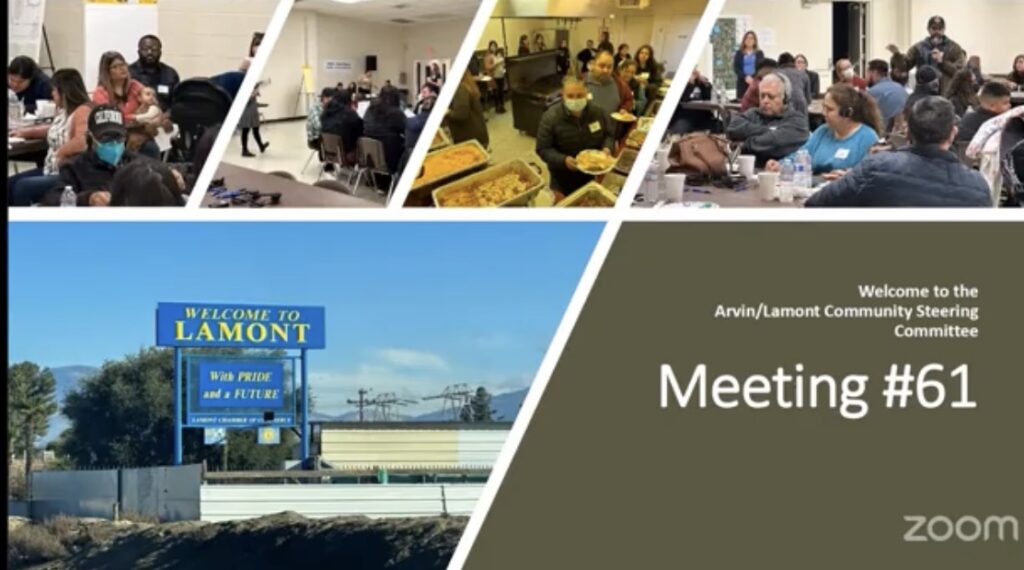
During the July 22 community Steering Meeting with the San Joaquin Valley Air Pollution Control District (SJVAPCD), residents, organizations, and the public discussed updates from Caltrans, vegetative barriers, Community Emissions Reduction Program (CERP) measure implementation, and the upcoming city’s plans.
During the previous meeting, residents asked if there is a policy in Kern County that protects existing greenery or requires planting new greenery when a new business opens. According to the Kern County Lamont Park Project, there is a specific requirement to protect existing trees during construction and a one-year guarantee following the finished project. Additionally, trees planted through the AB 617 Urban Greening Grant must be maintained for 10 years.
See Thao, Air Quality Specialist, at the Grants Department, provided a presentation of the vegetative barriers proposal for the Arvin and Lamont area. A request for the proposal of RFP opened in March for 45 days, and the deadline was on May 14th. The total funding for the proposal was up to $500,000, and there was one request from Dosanjh Bros LLC.
Dosanjh Bros’ purpose of their project is to plant new trees as vegetative barriers to address dust or other critical environmental challenges in the region. They are proposing to plant 150 trees and/or shrubs.
- Planting an evergreen native tree that can grow up to 12 feet tall.
- This particular shrub can reduce harmful air pollutants and help improve local air quality.
- Creates a dense vegetative barrier that captures dust, smog, and other airborne particles.
- Enhances surrounding landscapes
The growers are expecting around a two- to three-month period for the project to be implemented and completed. They are requesting a budget of $13,886 for the entire project costs and have identified one location that they are proposing to plant long sections of Ralph Avenue near the agricultural field. Their goal is to plant trees to create a buffer between agricultural operations and near residents’ homes.
The presentation mentioned that there is additional funding available and that they will be reopening the RFP for vegetative barriers and conducting outreach to agencies and local farmers.
Many community members expressed their support for the project; it was approved without opposition.
Byanka Santoya, community Co-leader part of the Arvin and Lamont Steering Committee, shared her thoughts on the vegetative barrier mapping, asking if Dosanjh Bros LLC can reapply to incorporate more areas to include Weedpatch Park.
“We have Weedpatch Park; it would be great to see a vegetative barrier, and if the grower can reapply to incorporate that area.”
Gustavo Aguirre, Director of Organizing at the Center on Race, Poverty & the Environment (CRPE), also shared his comments on recommendations for the project’s approval.
“I think if the grower can apply to also build the green barriers by the park, that would be good. That will not only benefit the people that use the park but also the people that drive on that street; it will benefit both,” said Aguirre.
Sarah Hasan Lane from the San Joaquin Valley Air Pollution Control District said that contracting will be moving forward, and the grower said it would take two to three months.
Liz Lev, research associate at Harder+ Company, addressed that there is remaining money from the budget, and the same grower can apply for additional grant funds to expand. According to Lane, there is a total of $486,000 left over for RFP to use and encourages them to apply.