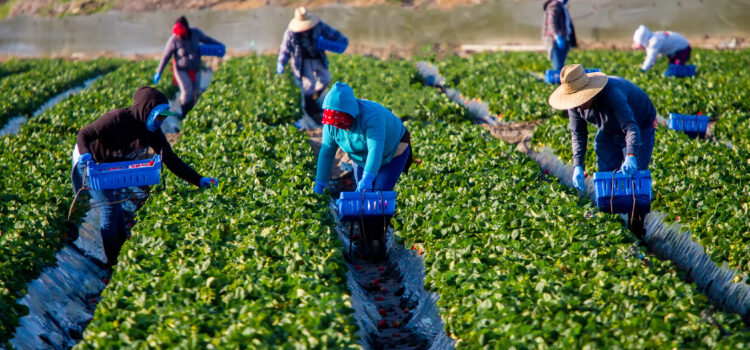
The United Farmworkers Foundation (UFW) and the United Farm Workers of America hosted a press conference to announce a lawsuit filed against the Trump Administration regarding the wage cuts to H-2A farmworkers. The lawsuit consists of 18 farmworkers. H-2A farmworkers are workers who come to the U.S from other countries on work visas for a specific employer.
Teresa Romero, President of UFW, spoke about the concerns this year of President Donald Trump’s immigration policies on agriculture, and stated that farmworkers have been on a “one-two punch,” citing the immigration raids and now the wage cut to H-2A workers.
Romero explained that the cut to H-2A farmworkers will impact all farmworkers, not only those using the visa but also undocumented farmworkers and U.S citizens. She added that despite the claims that Americans will not do these jobs, the majority of the 18 plaintiffs in the lawsuit, she stated, are U.S citizens. She stated that these claims erase the “Americaness” of the farmworkers.
“When you say that Americans won’t do these jobs, you’re saying that American farmworkers, like many of our plaintiffs, don’t count as real Americans. That is wrong. It’s ironic that the Trump administration officials have said publicly that they want a 100% American workforce. This wage cut is the opposite of that,” said Romero.
The H-2A is the opposite of wanting an all-American workforce because there is no cap on how many H-2A workers employers can hire for lower rates, and it undercuts American wages, according to Romero.
“There is nothing American first about extending exploitative guest worker programs of undercutting American wages,” said Romero. “That is what this lawsuit is about, defending the jobs and wages of American workers.”
According to Mario Martinez, President at Martinez Aguilasocho Law, Inc., a reason for these wage cuts would be to increase the H-2A labor force, and many of the workers are not familiar with the law for regulating employment or unionizing to have better working conditions.
“When workers come to work on an H-2A visa, they are tied to a particular employer; they don’t have freedom of contract, they’re not allowed to leave to go find work somewhere else. If they’re being mistreated, abused, or exploited, they have to stay with that employer or go back if they don’t like it,” said Martinez.
The lawsuit is also to defend the original sentiment of the H-2A program, which Romero stated is to prevent adverse effects; however, this wage cut is creating an adverse effect.
“That’s why it’s called the adverse effect wage rate, because it is designed to prevent an adverse effect. When you lower it artificially below the wages of American workers, you’re creating an adverse effect. You’re, in fact, breaking the law,” said Romero.
In California, Erica Lemeli Cororan, CEO of UFW Foundation, stated that the wages would go from $19.97 to $16.45; however, if they are in employer-provided housing, there is an additional pay cut, making their pay $13.45. This would be below the California minimum wage.
Lori Johnson, Legal Director and Senior Attorney for Farmworker Justice, spoke about the living conditions of H-2A workers in employer-provided housing to explain that it does not make up for the pay cut. She broke down that the Department of Labor uses the statewide average for fair market rents for a four-bedroom residence provided by the U.S Department of Housing and Urban Development (HUD) to decide how much is cut in wages.
The issue, according to Johnson, is that the living standards for migrant camps are set by the Occupational Safety and Health Administration (OSHA,) which has significantly lower standards than HUD.
“So if you go to a migrant labor camp, you may see ten toilets all in a row with no dividers between them, no privacy at all. That’s if they even have flush toilets. Outhouses are still allowed,” said Johnson.
This is not permissible through HUD but is common practice in migrant labor camps, according to Johnson, who stated HUD can not be applied to all farmworker housing for the wage cut.
Cororan spoke about specific stories of people involved in the lawsuit; one person she mentioned was Isabel Panfilo, who, according to a press release from the UFW, is 23 and works in Ventura County, California, and is a U.S.-born citizen.
“Isabel is not only working to pay for her school, but she’s also helping to support her family. It’s already hard to cover everyday expenses, as you all know, and with the pay she currently gets, she can’t imagine what will happen once these wages start lowering,” said Cororan.
“The work that I do is extremely difficult and challenging. Picking strawberries and packing them is extremely skilled work. You are held to very high standards: you are expected to be on time and work hard and fast to fill a lot of boxes to earn good money,” said Panfilo in the press release.
In the press release, Panfilo also spoke about the fear of being replaced by H-2A workers and the recent working conditions.
“The threat of guest workers is really concerning because they are planning to replace local workers with H-2A workers, that will make finding work more difficult,” said Panfilo. “Although I work very hard, it is difficult to cover everyday expenses. Recently, after the extreme rains, we are expected to show up to work to harvest berries in knee-deep water while it’s extremely cold. The work that farm workers do every day is extremely difficult and deserves a lot more respect than it gets.”
Romero stated that in order to solve the issues within the agricultural workforce, the workers must be free.
“Any long term solution to our agricultural labor challenges has to begin with taking care of people people who are already here, doing the work and have been for decades, by providing them with a fair wage and also the path for citizenship, they deserve,” said Romero, “We want agriculture workforce, made up for workers who are free, free as citizens, free to collectively bargain, for greater wages, free from hunger, and poverty, and and free to leave their job if they find a better opportunity elsewhere.”