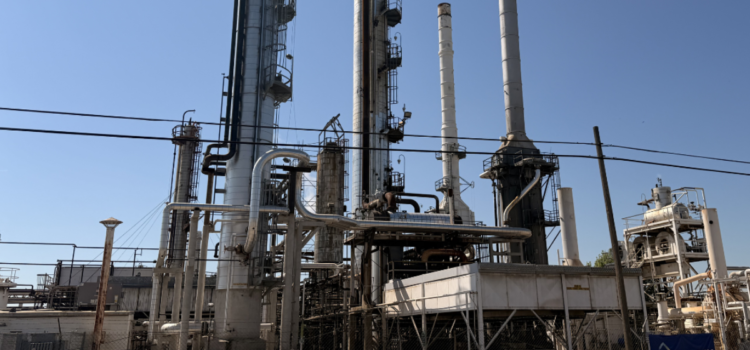
Residents from Fuller Acres and Lamont urged the San Joaquin Valley Air Pollution Control District’s Southern Region Hearing Board on August 12 to consider their decades of experience living near the Kern Energy refinery as it weighs an appeal to the company’s proposed hydrogen project. They described persistent odors, pollution concerns and fears about refinery emergencies while asking the board not to narrow the issues it will consider in the appeal.
The board ultimately sided with the Air District and removed two claims involving environmental review and the Arvin/Lamont Community Emissions Reduction Program (CERP). However, the board allowed the appeal to continue and scheduled a hearing on the remaining permit challenges for October 14.
Maria Martinez, who has lived in Fuller Acres for more than 35 years, told board members that regulators and refinery employees can leave the area after work, but residents cannot escape the conditions surrounding their homes.
“You work for the refineries, but you go back to your homes,” Martinez said. “But we live there 24 hours a day, 365 days a year.”
Martinez said residents have repeatedly raised concerns about odors, pollution, and a lack of communication regarding industrial projects in their community. She asked board members to consider how they would respond if a company proposed a similar project near their own homes.
“What would you do if something were to be placed in your community, in your yard, because I have more money, or I have higher authority?” Martinez asked. “That’s not how it works.”
Alicia Hernandez, who has lived less than a mile from the refinery for more than 20 years, focused on emergency preparedness. She questioned whether residents and local agencies could respond quickly enough to an oil spill, gas leak or other accident at the facility.
“I don’t think they’re prepared for such an emergency if there is a leak from oil, gases, or dangerous liquids,” Hernandez said. “And I think about me sleeping and thinking I might not wake up.”
The 184 Community Action Group and Comité Progreso de Lamont filed the appeal after the Air District issued Kern Energy an Authority to Construct permit on April 30. Leadership Counsel for Justice and Accountability represents the 184 Community Action Group, while the Center on Race, Poverty and the Environment (CRPE) represents Comité Progreso de Lamont.
According to Kern Energy, the project would recover hydrogen that the refinery already produces, purify it and send it to seven proposed fuel cells to generate electricity for refinery operations. Kern Energy operates the refinery at 7724 East Panama Lane, near Fuller Acres, Lamont and Athal.
The community groups want the hearing board to revoke the permit. Their appeal alleges that the Air District underestimated volatile organic compound emissions, relied on an invalid pollution-offset credit, failed to evaluate all refinery equipment the project would affect, and did not require the best available pollution controls. The Air District and Kern Energy dispute those allegations.
The August 12 hearing did not address the merits of those technical claims. Instead, board members considered an Air District motion to remove the appeal’s claims involving the California Environmental Quality Act (CEQA) and CERP.
The Air District approved the permit after determining that the project qualified for an exemption from a full environmental review. District attorneys argued that petitioners must bring any CEQA challenge before a Superior Court because the hearing board lacks the authority to decide it.
District attorneys also argued that the CERP does not create an independent permitting standard that the hearing board can use to overturn the permit. The district developed the plan under Assembly Bill 617 to reduce pollution in communities that face some of the state’s highest pollution burdens.
Attorneys representing residents argued that the Air District could not separate the permit from the environmental conditions and pollution-reduction commitments that affect the surrounding community.
“All of the associated impacts must be considered in order to properly evaluate the permit,” said Vivyana Prado, an attorney with Leadership Counsel.
Residents also told the board that they had spent years participating in the Arvin/Lamont emissions-reduction process with the expectation that it would directly address pollution. Diana Morales of Comité Progreso de Lamont said the community needs measures that reduce contamination, not only projects that improve neighborhood infrastructure.
“It’s not about creating these projects about the sidewalks or the bike lanes,” Morales said through an interpreter. “It’s about reducing contamination in the community.”
Lamont resident Tim Prado also urged the board to consider the emissions-reduction plan when reviewing a new project at the refinery.
“The CERP was adopted by the district to protect communities like mine,” Prado said.
Other environmental justice advocates also urged the board to consider the refinery’s compliance history and the conditions surrounding it. Cesar Aguirre of the Central California Environmental Justice Network said recurring enforcement actions show that existing oversight has not prevented violations.
“They are taking the violations as a cost of business and continuing to break the rules over and over again due to a lack of proper oversight, compliance, or any other statutory enforcement that would prevent these things from reoccurring,” Aguirre said.
Emma De La Rosa, land use and transportation policy manager with Leadership Counsel, said she has worked alongside Fuller Acres and Lamont residents for about six years. She said officials must consider the conditions residents already face when reviewing a new industrial project.
“When you are proposing a project, or you’re considering the impacts of these projects, you have to take a look at the impacts that residents are currently facing,” De La Rosa said. “You have to consider the current condition of the community and of the project location.”
Kern Energy representatives told the board that the project would help the refinery operate more efficiently while reducing several types of emissions. Zach Powell, an attorney representing Kern Energy, described the proposal as “simply a way to purify existing hydrogen to make it cleaner, safer and more productive and usable at existing facilities.”
He argued that the project would recover hydrogen from existing refinery processes rather than create a new source of hydrogen.
Don Van Sickle, a Kern Energy employee who said he lives near the refinery, defended the company’s environmental record. “We’ve never had an environmental issue with the refinery there,” Van Sickle said.
Residents and public records challenge that characterization. The EPA’s Enforcement and Compliance History Online database lists 221 notices of violation or other informal enforcement actions in its 10-year view for the Kern Energy facility. A June 2026 multi-agency compliance report separately lists 175 Air District enforcement actions at the refinery between 2018 and 2025 involving leaks, excess emissions, hydrogen sulfide limits, vapor-recovery equipment, monitoring and reporting.
After hearing from residents, attorneys, Kern Energy representatives and Air District staff, the board granted the district’s motion and removed the CEQA and CERP claims. The board’s chair emphasized that the ruling did not erase residents’ concerns or prevent them from presenting facts about pollution and community conditions during the next hearing.
“We’re taking away two of these issues, CEQA and CERP, from this hearing board’s determination,” the chair said. “Those issues don’t evaporate. There may be other forums.”
The October 14 hearing will focus on the remaining allegations involving emissions calculations, pollution-offset credits, affected refinery equipment and pollution-control requirements. Residents will still have an opportunity to explain how the refinery’s operations affect Fuller Acres, Lamont and other nearby communities as the board considers whether the Air District properly issued the permit.