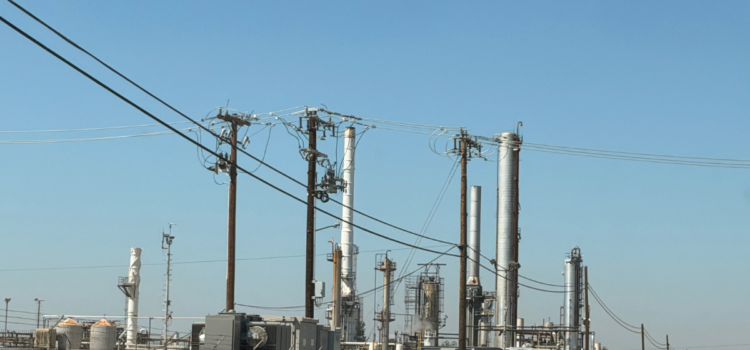
Residents of Fuller Acres and Lamont plan to continue challenging an air permit for Kern Energy’s proposed hydrogen project after a regional hearing board narrowed the scope of their petition last week, leaving a more technical dispute over how the project’s emissions were calculated, which will be heard in October.
On August 12, the Southern Region Hearing Board of the San Joaquin Valley Air Pollution Control District ruled that it could not consider claims related to the California Environmental Quality Act (CEQA) or the Arvin-Lamont Community Emissions Reduction Program (CERP) when deciding whether Air District staff properly issued Kern Energy an Authority to Construct (ATC) permit.
Vivyana Prado, an attorney with Leadership Counsel for Justice and Accountability who represents Fuller Acres residents in the challenge, said the ruling was not what petitioners had hoped for, but it does not end their case.
“That is contrary to what we were hoping that they would conclude, but we’re going to continue forward in our permit challenge,” Prado said. “There’s really strong community momentum on the ground to continue this challenge against the ATC permit.”
The Air District issued Kern Energy the ATC on April 30 for a hydrogen power generation operation at its refinery at 7724 E. Panama Lane. District documents describe the project as including fuel cells, a hydrogen purification unit, and hydrogenation and dehydrogenation process units. The District’s application review says Kern Energy plans to recover hydrogen that could be used in one of seven 3-megawatt fuel cells for on-site electricity generation or stored for future use.
Kern County separately filed a Notice of Exemption under CEQA for construction of a hydrogen recovery and power production unit at the existing refinery, determining that the building permits were ministerial and exempt from environmental review under the cited provisions of state law.
Leadership Counsel and the Center on Race, Poverty & the Environment (CRPE) challenged the Air District permit on behalf of Fuller Acres residents and Comité Progreso de Lamont. Prado said the petition grew out of residents’ broader concerns about the concentration of industrial activity and pollution in the communities surrounding the refinery.
“When we first became aware of the permit, and we talked to residents about it, the first thing that they really said was, ‘We can’t deal with this anymore,’” Prado said.
Residents told attorneys they were already facing cumulative environmental burdens that affected their ability to live healthy lives, Prado said, including concerns about air pollution, respiratory problems, cancer risks and contaminated water.
“They just cannot take one more siting of a new industrial project in their neighborhood,” Prado said. “Any type of expansion or construction going on in their vicinity has such detrimental impacts to their everyday lives, and they just cannot stand it anymore. They want to be heard.”
Kern Energy’s refinery is located within the Arvin-Lamont area selected by the state for additional air-quality resources under Assembly Bill 617. The law calls for added monitoring, reporting and community-developed emissions reduction strategies in communities disproportionately affected by air pollution. The Air District adopted the Arvin-Lamont CERP after the area was selected in 2021.
Although the Hearing Board determined it would not consider the petitioners’ CEQA and community emissions reduction program claims in its review of the permit, one central claim remains.
That claim focuses on Air District Rule 2201, the District’s New and Modified Stationary Source Review rule. Prado said the rule is incorporated into the broader state implementation framework used to meet federal Clean Air Act standards and governs how the District evaluates pollution from new or modified stationary sources.
Petitioners contend the Air District did not properly calculate emissions associated with the hydrogen project before issuing the permit.
They also argue the District failed to account properly for operational changes that would occur elsewhere within the refinery as a result of bringing the hydrogen operation online, Prado said.
“The arguments that we’ll be making on the 14th are going to be a lot more technical,” Prado said. “They’re related to more of the engineering evaluation of the project and background calculations and more of those technical aspects of the project.”
The Southern Region Hearing Board is scheduled to meet October 14.
Between now and then, Prado said attorneys will continue strengthening their technical arguments while remaining in close communication with residents. Leadership Counsel represents residents in Fuller Acres, while the Center on Race, Poverty & the Environment is working with Comité Progreso de Lamont.
Formal community events ahead of the hearing are still being developed, Prado said, but conversations about the project are continuing among neighbors.
“There’s a lot of conversations happening in the communities about the project,” Prado said. “It’s truly just people talking to their neighbors and spreading the word.”
She said organizers want to make sure people living near the refinery understand both the proposed project and the ongoing challenge before the October hearing.
“We want to do our best to make sure that everybody in the vicinity of the project is informed,” Prado said.
The Kern Energy dispute is also unfolding as environmental and community organizations pursue other legal challenges involving air-quality regulation in the San Joaquin Valley.
Prado pointed to those cases as evidence that the permit challenge is part of a broader struggle by environmental justice communities over how air pollution laws are implemented in one of the nation’s most polluted air basins.
One of the most recent decisions came August 5, when the U.S. Court of Appeals for the Ninth Circuit ruled in Committee for a Better Arvin v. U.S. Environmental Protection Agency. The San Joaquin Valley Air Pollution Control District was not the defendant in that case, but intervened alongside the California Air Resources Board in defense of the EPA rule being challenged.
The case is separate from the Kern Energy permit dispute and does not decide whether the hydrogen project was properly permitted. Instead, it centered on California’s plans for meeting federal fine-particle pollution standards and what backup measures must be available when the Valley falls short of Clean Air Act requirements.
Under the Clean Air Act, states must develop state implementation plans describing how areas that do not meet federal air-quality standards will come into compliance. Those plans must also include contingency measures that can take effect if an area fails to make sufficient progress or misses an attainment deadline.
For the San Joaquin Valley, California proposed contingency measures that included tighter residential wood-burning restrictions, expanded fugitive-dust controls and additional vehicle smog-check requirements. The dispute centered in part on nitrogen oxide, or NOx, reductions, which fell short of the EPA’s recommended target. California and the Air District had provided feasibility analyses explaining why additional measures could not reasonably be adopted as contingency measures.
In a 2-1 decision, the Ninth Circuit concluded that the EPA exceeded its authority by allowing a feasibility exception that Congress had not included in Section 172(c)(9) of the Clean Air Act. The majority said feasibility considerations appear explicitly elsewhere in the Act, but not in the section governing contingency measures.
The court sent the EPA rule back for reconsideration but did not vacate it, meaning the existing contingency measures remain in effect while the agency responds to the decision.
Judge Daniel Bress dissented, arguing that considerations described as “feasibility” were actually necessary to determine whether proposed measures could take effect automatically and quickly enough to qualify as contingency measures. He warned that the majority’s interpretation could leave states choosing between adopting measures they cannot realistically implement and facing federal sanctions.
Prado said that broader legal history matters because residents’ current challenge to the Kern Energy permit is not the only instance in which environmental justice organizations have questioned how air-quality rules are being implemented in the Valley.
“This isn’t an isolated incident,” Prado said. “This is part of a pattern that a lot of different environmental justice advocates and communities have tried to address over the years.”
For Fuller Acres and Lamont residents, however, Prado said the immediate focus remains the October hearing and the remaining arguments over Kern Energy’s permit.
“Residents want to advocate for what they deserve,” she said. “And they know that they deserve to breathe healthy and clean air.”