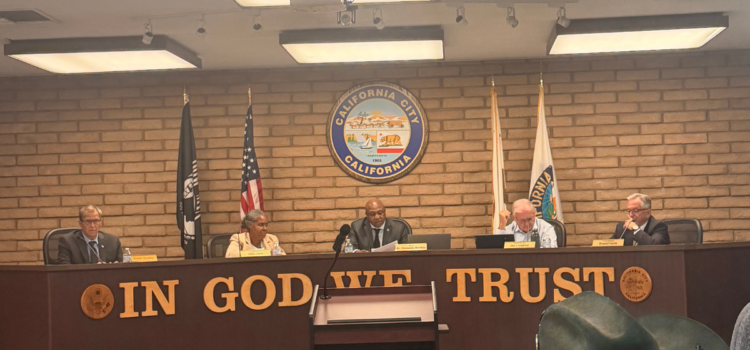
Following hours of legal arguments and public testimony, the California City Council voted Tuesday to reject two appeals challenging CoreCivic’s 2026 business license and Minor Site Plan Review 25-09.
Each decision passed 4-1, with Councilmember Sean Bradley casting the lone dissenting vote. The votes upheld two city approvals allowing CoreCivic to continue operating a federal immigration detention facility in California City.
The appeals, filed by the Dignity Not Detention Coalition, centered on a fundamental land-use question: Does the facility’s longstanding authorization as a prison or correctional facility permit its current use for civil immigration detention, or does that use require a new conditional use permit?
City staff and CoreCivic maintained that the current operation falls within the correctional use previously approved for the property. The coalition argued that civil immigration detention is a materially different use that is not expressly permitted under the site’s zoning.
The dispute came amid broader community concerns about conditions inside the facility, California City’s economic relationship with CoreCivic, and the extent of the city’s authority over federally owned property.
The first appeal challenged the city’s issuance of CoreCivic’s 2026 business license.
According to the city’s presentation, CoreCivic applied for the license in August 2025. The city issued it in February 2026 after completing the related site-plan process. The coalition appealed the approval, but City Manager Sean Grayson upheld the license in July, prompting the appeal to the council.
City staff characterized the business-license process as largely ministerial. Once an applicant submits a verified application, pays the required fee and receives the necessary health, fire and zoning approvals, staff argued, the city clerk lacks discretion to deny the license.
Coalition attorney Jehan Laner argued that a business license could not legitimize an underlying land use that violated the city’s zoning code. She said CoreCivic began holding ICE detainees months before receiving the license and contended that the existing conditional use permits authorized a prison, not an exclusively civil immigration detention center.
Laner also argued that the facility’s reported capacity of 2,560 beds exceeded the capacity authorized by an earlier permit. The city, she said, should require CoreCivic to apply for a new conditional use permit and undergo the same public land-use review expected of other applicants.
“We are here simply asking you to deny this application under the authority that you do have,” Laner told the council during her rebuttal. “And there is a legal basis for you to do so.”
Attorney Daniel P. Struck, representing CoreCivic, said the property’s correctional-facility permits had never expired or been revoked and continued to run with the land. He argued that holding federal detainees at the site was not a new activity, and pointed to its history of housing people in the custody of ICE, the U.S. Marshals Service and the Federal Bureau of Prisons.
“This is not a surprise. It’s not a different use,” Struck said. “This is the use that has been accepted and understood by California City throughout the operation of the facility.”
The public-comment period was dominated by speakers asking the council to grant the appeal. Their testimony combined land-use arguments with personal accounts, economic concerns and allegations about conditions inside immigration detention facilities.
Alex Gonzalez, a Kern County resident who works with faith communities on immigration issues, rejected the suggestion that the council had to choose between employment and concern for detained people. He told council members that every person inside the facility possessed inherent human dignity.
“No contract, corporation or amount of money makes a human life disposable,” Gonzalez said. “Years from now, the question will be simple: You knew. You had the power. What did you do? Your vote will answer that question.”
California City resident Ali Jackson framed the issue as one of local accountability and the public’s ability to influence its elected officials.
“At the end of the day, all I have is my voice and my protest,” Jackson said. “It’s not too late to make this better, to work with the citizens of California City to help find a way forward. If you cannot spare humanity, the very least you owe us is transparency.”
Several other speakers urged the city to invest in schools, parks, health care and employment that did not depend on detention. Others accused the city of enforcing its rules unevenly by taking action against smaller businesses while allowing CoreCivic to operate before receiving its license.
“I’m wondering what kind of city you want to be known as,” said resident Martha Larson. “You could be more than that. You could be brave. You could take a risk. You could be known for your schools. You could be known for choosing a development plan that gives jobs to your people instead of having them work in detention centers.”
Formerly detained speakers and their advocates described family separation, inadequate medical treatment, cold living areas and poor sanitation. Some commenters cited findings from a California Department of Justice inspection report. Others urged council members to visit the facility without advance notice, eat the food served there and speak privately with detained people.
Hawkins responded that he had visited the facility four times, including once without advance notice. He also said he had advocated for repairs to its air-conditioning system.
The council ultimately voted to uphold the business license. Councilmembers Della Clark and Ronald Smith, Mayor Pro Tem Creighton and Hawkins voted in favor. Bradley voted against the motion.
“I’m going to follow the law, and I’m going to say no to upholding it,” Bradley said before casting his dissenting vote.
The second hearing concerned Minor Site Plan Review 25-09.
City staff emphasized that the approval did not authorize construction, grading, additional detention housing, an expanded footprint or a new conditional use permit. Staff said the review concerned continued use of the existing buildings and site.
Staff cited the property’s original conditional use permit, a later amendment, the city’s 2009 General Plan and a 2010 agreement involving federal detention services as evidence that California City had historically recognized federal detention at the facility.
Planning Director Anu Doravari told the council that CoreCivic’s initial operating statement referred to ICE. The company later withdrew that statement and submitted another one without the ICE references, stating that the facility would operate under its originally approved use.
Laner argued that removing those references did not alter the facility’s actual purpose. She maintained that civil immigration detention was not equivalent to incarceration following a criminal conviction and was not expressly listed as a permitted use in the property’s zoning district.
“Legally, it is civil. It is not punitive. It is not a comparable use,” Laner said. “If the city were to consider that, the local code requires the Planning Commission and City Council to formally resolve that ambiguity. That has not occurred here.”
Struck responded that the facility was constructed for confinement and had long been used for different categories of federal detainees. He maintained that its present operation conformed to the established correctional use and pointed to a visit by Bishop Joseph Brennan and other faith representatives, who Struck said reported clean conditions in the portions of the facility they saw.
Public commenters criticized the city’s reliance on a general dictionary definition of “prison” when evaluating whether immigration detention fit the approved use. They urged the council to rely instead on land-use law and distinctions between civil detention and criminal incarceration.
Robby Kumar criticized both the legal analysis and the information provided during the Planning Commission’s review.
“You have counsel who is referencing the dictionary as how they came about with conflating criminal enforcement with civil immigration,” Kumar said. “This is nonsensical. I’ve never heard an answer like that.”
Other testimony returned to conditions inside the facility.
A formerly detained woman identified as Ale said she was denied medicine and mobility assistance while detained.
“When I was inside, I used to ask for my medicines. I am diabetic, and I also need heart medicine. I wouldn’t receive that,” she said. “My feet were inflamed; I would ask for a wheelchair or a walker, and I didn’t get anything. They really made my life a living hell inside.”
Gonzalez returned during the second hearing and argued that, regardless of CoreCivic’s financial resources or the federal government’s authority, council members remained accountable to local voters.
“Public accountability is part of public service. When human lives and public laws are at stake, the public has a responsibility to speak plainly,” he commented. “CoreCivic may have money. The federal government may have power. But CoreCivic does not elect you. The federal government does not elect you. The people of California City do. People are watching. People are organizing.”
During public comment on the site-plan appeal, speakers argued that the facility’s land-use compliance could not be separated from the condition and safety of its buildings
“The building has decayed since that time,” Jewett said, citing the state Department of Justice report. “It details the crumbling infrastructure and also later details the water that is not drinkable. It can be brown, smell funny [and] give you gastrointestinal and mouth [problems].”
Others said the reported problems extended beyond the facility’s physical condition to broader deficiencies in staffing, health care and daily operations.
“The report directly contradicts the CoreCivic attorney’s statements that things are going well in the facility. California DOJ received repeated reports from detained people that conditions were consistently worse at California City than other facilities where they had been housed,” a commenter identified as Olivia stated. “Even as conditions improve, these are still cages run by CoreCivic. These people are still caged. What are good conditions in cages?”
Councilmember Smith moved to deny the site-plan appeal and uphold the Planning Commission’s approval. He said the city was required to approve a site plan that conformed to its code and that personal opinions about immigration detention were not the legal standard governing the appeal.
Councilmember Bradley attempted to make a substitute motion granting the appeal. He argued that immigration detention was not identified as a permitted use in the agricultural zoning district and was legally different from a prison. His motion failed to receive a second.