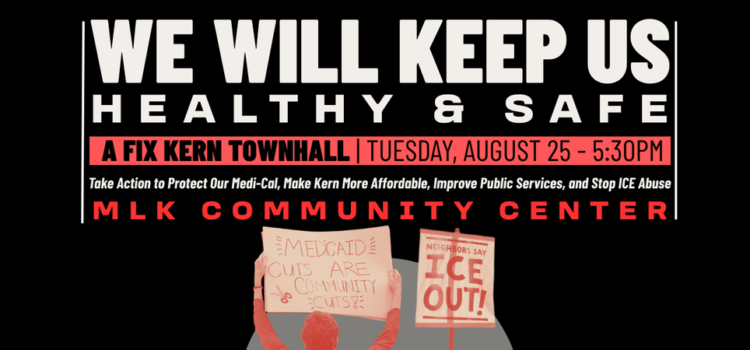
Community organizations held a town hall forum and resource fair on August 25 in Bakersfield, where community members gathered to connect with individuals impacted by the Medi-Cal cuts. The forum discussed solutions to Medi-Cal cuts and information to support immigrants and their families.
Many hospitals in Kern County, such as Kern River Valley Hospital and Adventist Hospitals in Tehachapi and Delano, are at risk of closing if Medi-Cal is cut, affecting many families.
New work requirements for Medi-Cal will take effect in January 2027, following Congressman David Valadao’s vote in favor of House Resolution (H.R. 1).
Several community members strongly voiced that they are, or that someone they know is, being affected by the Medi-Cal changes and expressed their disappointment. Keri McKinney with Fix Kern spoke about how these changes are affecting almost everyone in her life and preventing them from getting the care they need due to federal cuts.
“So they’re affecting almost everyone in my life, and the way that they’re affecting them is, they’re not gonna all be able to get the care that they need. I have a lot of disabled family members. I have a lot of elderly family members, and the cuts will deeply affect them,” said McKinney.
McKinney shared how important it is to be aware of what is happening around in the community, as anyone could be affected.
“It’s important to be aware so that way you know what’s going on around you, because even if it doesn’t affect you right now, it can affect you tomorrow,” said McKinney.
A conversation took place with speakers from different organizations, following a community discussion about taking action to protect Our Medi-Cal, make Kern more affordable, improve public Services, and stop ICE abuse.
Dr. Randy Villegas, a professor, auto repair shop owner, and school board trustee for the Visalia Unified School District, opened the forum by sharing his personal experience with Medi-Cal, having lived in Bakersfield as a child and with his family relying on Medi-Cal, WIC programs, and SNAP to ensure they were healthy. He noted that the administration is cutting Medicaid by $880,000,000,000, giving more tax breaks to billionaires across the country. He asked the public who relies on Medi-Cal and has traveled out of the country to afford basic health care, and several residents said yes, they rely on it and have traveled due to their inability to afford medication and dental care.
He discussed that the U.S. is one of the richest countries in the world and that these issues should not be happening.
“We deserve better than that here, but it’s because we have elected officials who are bought and paid for by these special interest groups, by these health insurance companies, by big pharma who want to continue to take advantage of us,” said Villegas.
Kellie Pollack, Director of Analytics and Public Health for Kern Medical Center, presented information on protecting Medi-Cal health care, as roughly 200,000, or 70%, of Bakersfield residents rely solely on the program. Pollack stated that 83% of moms, labor and delivery, and moms’ health rely on Medi-Cal. She explained that Medi-Cal pays for special education in schools from kindergarten through high school, and the cut to Medi-Cal will eliminate that coverage.
She continued to discuss how Kern County is one of the premier teaching facilities in the Central Valley and provides a safety-net hospital for the valley. She explained that many individuals who can’t afford to pay will attend Kern Medical, a trauma 2 hospital, and are at risk.
“Kern Medical is one of the 17 public health system facilities that is in danger of losing its funding,” said Pollack.
Ana Alicia Huerta, an immigration attorney and representative with Rapid Response Network of Kern (RRN), provided community members with information on protecting individuals from ICE and on immigration resources. She addressed the public, informing them that there is an ICE office in Bakersfield. She described RRN as a volunteer network of local non-profits in Kern County that provides support to protect the community.
Huerta noted that anyone is at risk, especially people of color and people who speak more than one language, of deportation. She said every person, regardless of immigration status within U.S. jurisdiction, has rights and can have an attorney. Still, it’s not the same process as when arrested in criminal proceedings.
Huerta explained that in the past year, 70,000, or 74% of ICE arrests, were made without criminal immigration charges, an increase of 11 times compared to 2024. She stated that in June of 2026, ICE arrested 43,000 people throughout the nation, making it the highest number of arrests and rapidly increasing detention capacity.
Huerta noted that there are four active, open detention facilities here in Kern County: Mesa Verde, Golden State Annex and Central Valley Annex, McFarland, and the largest detention facility in California, California City. She explained that Kern County has the total capacity to detain over 4,000 people.
Tommy Rico with SCIU Local 1000 shared that the new changes will affect several of his family members due to cuts, a lack of available clinics, and new requirements, which will force them to seek new medical services.
“They’re getting the impact letters of what’s gonna be affected, where they can be seen. So a lot of it is the lack of available clinics that there are, you know, ’cause there are some clinic closures that are happening,” said Rico. “ And so I think the hardest part is finding adequate services near them, as well as new requirements. And so some of them, some of my family members are gonna be kicked off of Medi-Cal, and they’re gonna have to find then a different medical insurance to provide the medical care for them and their kids.”
He emphasized the importance of recognizing that the state is the fourth-largest economy, yet people cannot afford health care.
“I think it’s very important because we hear a lot about how our country is the richest in the world, how our state is the 4th largest economy, right? But yet, we can’t afford to take care of our people who live here in the state,” said Rico. “I feel that people want their tax dollars to go towards taking care of our community, right? We’re tired of seeing all these tax cuts for billionaires and big corporations. We want our people, our community, taken care of with our tax money.”
Rico explained that many people don’t realize that avoiding dental care affects kids’ lives and emphasized the importance of prioritizing it in funding.
“That’s the one thing that I don’t think a lot of people understand: it’s even dental care. We have a lot of kids that, right now, with a lot of the different cuts that have been happening over the years, and what’s proposed to go again in January, are putting off dental care for their kids. And that’s an important preventive step that we need to prioritize more: we need our kids to have better preventive care for their dental health, because it does lead to lasting impacts,” said Rico.
He spoke about his family members not taking proper care of their teeth when they were young and, as a result, having to travel out of the country for treatment as adults, because costs are significantly higher than in-state.
“You know, I have several cousins who, as kids, weren’t properly taking care of their teeth, and now, as adults, they’re having a lot of issues. They’re having a lot of issues; they’re going, you know, into Mexico for dental care. So I think it’s really hard to see how these impacts have basically the fact that it’s cheaper to go out of the country,” said Rico.
