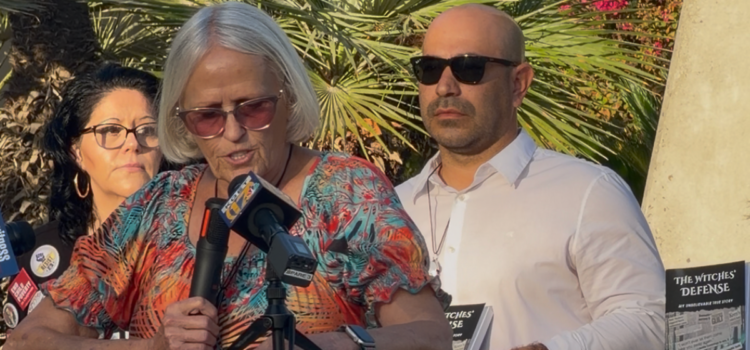
Community advocates gathered at the Liberty Bell in downtown Bakersfield Thursday morning, asking whether former Kern County Supervisor Zack Scrivner’s political connections played a role in how his criminal case was handled.
Organizers said they were not there to tell the court how to rule. They focused instead on the charges filed against Scrivner and the decision to grant him mental health diversion, asking whether someone without his former office or family ties would have received the same treatment.
Victoria Pilar, a community organizer and Brown Beret, summarized the case and asking whether someone without Scrivner’s name or former position would have received the same result.
“In December 2025, Judge Stephanie Childress granted mental health diversion, meaning he faces no criminal conviction and charges could be dismissed if he completes court-ordered requirements,” Pilar said. “The Fifth District Court of Appeal later upheld the decision. Today, we are demanding transparency and accountability. The question is simple: Would any ordinary citizen without political influence or connections have received the same outcome?”
Scrivner is the nephew of Kern County District Attorney Cynthia Zimmer. Because of that relationship, the state Attorney General’s Office handled the case rather than local prosecutors.
“We don’t want special treatment. We don’t want political favoritism. We don’t want decisions made behind closed doors,” said Julie Solis, rally host and community advocate. “We want justice without favor.”
Scrivner, who represented District 2 on the Kern County Board of Supervisors before resigning in August 2024, was charged by the California Department of Justice in February 2025 with three felony counts of child abuse and two felony counts of possessing assault weapons.
The charges followed an April 2024 incident at Scrivner’s Tehachapi home. Although the state’s criminal complaint alleges sexual penetration of a child as the conduct underlying one child abuse count, prosecutors did not charge Scrivner with a sex offense. The complaint also alleges that a child was endangered during a struggle involving firearms and that Scrivner illegally possessed AK-47- and AR-15-style rifles.
A Kern County Superior Court judge granted Scrivner pretrial mental health diversion in December 2025. Under the diversion process, the charges may ultimately be dismissed if he completes the court-ordered program. The California Attorney General’s Office later challenged the ruling, but the Fifth District Court of Appeal denied the state’s petition July 16, leaving the diversion in place.
That outcome, along with the absence of a separately filed sex charge, formed the center of Thursday’s rally.
Keynote speaker Jacqueline Etta Cummings said transferring the case to state prosecutors was appropriate given the familial connection. However, she said the charging decision and subsequent diversion ruling still warranted public scrutiny.
“The allegations against Zack Scrivner were sexual in nature, yet the Attorney General did not charge him with a sex offense,” Cummings said. “Without that sex charge, he remained eligible for mental health diversion, and he got it. That’s not proof of corruption, a scheme or anything. But it is absolutely enough to justify public scrutiny.”
Cummings questioned why Deputy Attorney General Joseph Penney did not file a sex charge but later sought to overturn the court’s diversion decision.
“Why wasn’t a sex offense charged by Deputy AG Joseph Penney?” Cummings asked. “Why did AG Penney turn around and ask the courts to overturn Scrivner’s diversion a year later? He wouldn’t have qualified for diversion if AG Penney had charged him with the sex crime his own children had alleged he’d committed.”
Cummings connected her concerns about the Scrivner case to Kern County’s history of overturned child molestation convictions from the 1980s. She is the author of “The Witches’ Defense: My Unbelievable True Story,” which recounts her family’s experience during the county’s widely criticized child molestation prosecutions.
Cummings said dozens of working-class residents were accused or convicted as authorities pursued allegations of organized child molestation. Several convictions were later overturned amid findings involving improper questioning of children and prosecutorial misconduct.
“I know what that system looks like when it decides to come after ordinary people. They don’t give up,” Cummings said. “So when a politically connected former supervisor accused of conduct this serious receives an outcome that could ultimately wipe the criminal case away, the public has every right to ask why.”
She maintained that Scrivner is entitled to the same constitutional protections as any other defendant, while arguing that his public position and family relationships should not insulate him from scrutiny.
“Zack Scrivner is entitled to every constitutional protection afforded to any defendant, but he is not entitled to escape justice just because of his name, his position or his family,” Cummings said. “We deserve a system in which allegations are taken seriously, regardless of the perpetrator’s political connections. We deserve justice without favor.”
Johnny Olaguez, a Bakersfield business owner and community advocate, criticized county supervisors for not publicly demanding Scrivner’s resignation after the allegations became public.
Olaguez named Supervisors Phillip Peters, Jeff Flores, David Couch and Leticia Perez, arguing that their silence contrasted with the board’s willingness to weigh in on other state matters. Scrivner continued receiving his county salary until he resigned after the April 2024 incident.
“You can submit a letter to the state demanding that the state is split into two, but you can’t submit a letter demanding that we protect our children, our kids,” Olaguez said. “I hope that this gets out there and we can reach more and more people every time that we meet here.”
Event organizer Lori Ann Wiley, a retired educator and community advocate, invited attendees to ask questions and encouraged residents to report misconduct they observe in their communities.
“If you see something in your community, then say something,” Wiley said. “We need more people that expect transparency and accountability, no matter who it is.”
Solis closed the rally by calling for greater public access to government decision-making, accountability when potential conflicts of interest arise, and consistent application of the law. She also announced that organizers intend to pursue an effort to recall Zimmer and invited residents to become involved through the Justice Without Favor organization.
“We don’t have to agree on everything. We don’t have to come from the same neighborhood. We don’t have to share the same politics,” Solis said. “But we should be able to agree on one fundamental principle: Justice should be blind to power in Kern County. It should be blind to political connection in Kern County. It should be blind to the wealth and status you hold in Kern County. Because if justice isn’t equal, then justice isn’t justice.”