Free health screenings, flu vaccines, and help accessing health coverage are among the resources Kern County families can get through this year’s Binational Health initiative, which focuses on bringing care directly to Latino and immigrant communities.
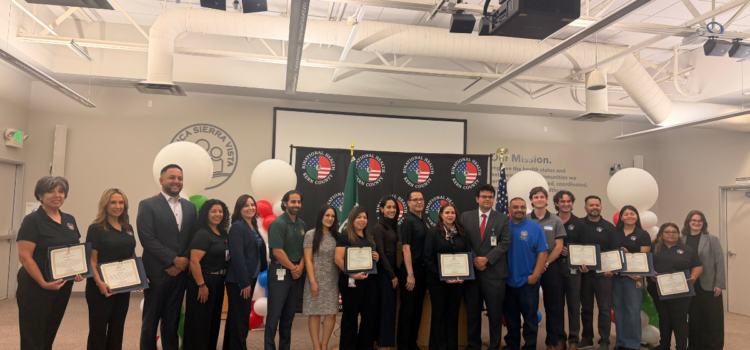
Binational Health Kern County launched its annual initiative September 30 at Clinica Sierra Vista, where organizers said language barriers, transportation, lack of information, fear and uncertainty about where to seek help can prevent families from accessing care.
This year’s effort will focus on chronic and communicable diseases, women’s health, nutrition, mental health and health care access, including Medi-Cal renewals. Organizers emphasized that services offered through the initiative are free, available in Spanish, and accessible regardless of immigration status.
“By bringing health resources directly into the spaces where our people live and work, we are breaking down barriers of fear, language, and distrust,” Consuelo Noriega said during the press conference.
Noriega said the goal is to mobilize local clinics, provide preventive health information to migrant families, and connect residents with reliable local resources.
“Taking care of our health is the greatest act of love we can show for our families,” Noriega said.
The local initiative is part of a broader Binational Health movement that brings together health care providers, government agencies, nonprofits and community organizations across the United States, Mexico and other Latin American countries.
In Kern County, that collaboration includes organizations such as Clinica Sierra Vista, Kern Family Healthcare, Dignity Health, the Mexican Consulate, the UFW Foundation, Building Healthy Communities, and other local partners.
Dr. Irving Ayala, deputy CEO and chief medical officer for Clinica Sierra Vista, said one strength of the initiative is that families can be reached through organizations with different relationships and areas of expertise.
“We want families to know that healthcare is within reach, and that there are people and organizations they can turn to, and that they deserve the care that respects who they are,” Ayala said.
That need is particularly significant in a region where thousands of patients are more comfortable receiving care in a language other than English.
Clinica Sierra Vista, which began in 1971 as La Clinica de Los Campesinos in a small trailer in Lamont Park, now serves more than 200,000 patients across Kern and Fresno counties. More than 70,000 of those patients are best served in a language other than English, according to Tram Chau, director of dental operations at Clinica Sierra Vista.
Chau said making care accessible includes ensuring patients can understand and communicate about the treatment they receive.
“Sometimes that means being able to communicate in the language that they’re most comfortable using,” Chau said. “At the heart of it, it means making sure people feel heard, respected, and cared for.”
Maritza Jimenez, community engagement supervisor with Kern Family Healthcare, said language is only one of several obstacles local families face when trying to obtain care.
“Many of the families we serve face barriers such as language, transportation, lack of information, or uncertainty about where to turn for help,” Jimenez said. “Binational Health Week helps remove those barriers by bringing trusted information, healthcare resources, and community partners directly to the people who need them.”
Jimenez also stressed the importance of preventive care and maintaining health coverage.
“When individuals and families have health coverage, they are more likely to receive preventive care, manage chronic conditions, and address health concerns before they become serious,” she said. “Prevention is one of the most powerful tools we have, and healthcare coverage helps make that prevention possible.”
She encouraged families to respond to Medi-Cal renewal requests, keep their contact information updated and remain connected with health care providers to avoid disruptions in coverage.
“This year, the message is more important than ever,” Jimenez said. “We must continue encouraging families to renew their medical coverage, respond to renewal requests, keep their contact information updated, and stay engaged with their healthcare providers so they do not lose access to essential healthcare services.”
Kern County Supervisor Leticia Perez tied access to health care to the county’s long history of immigrant and farmworker labor. Perez said her father began working as a farmworker in Kern County when he was six years old and described her family as part of the history shared between Mexico and the United States.
Kern County’s agricultural economy, Perez said, would not be possible without the workforce that sustains it.
“The health and well-being of our families and our communities make such a thing possible,” Perez said. “It is not possible otherwise.”
Perez said changes in health care policy make collaboration among local organizations increasingly important.
“We have to adapt to our environment. We have to adapt to changes in policy,” Perez said. “And that means that we have to be more creative and we have to do more with less.”
Bakersfield City Councilmember Andrae Gonzales also pointed to the health care challenges facing residents in Ward 2, which he described as containing some of the city’s oldest infrastructure and underserved communities.
“We know that in this day, this time, there are many stressors facing all families at all levels, all income levels,” Gonzales said. “Cost of living continues to increase.”
Gonzales said uncertainty around access to care and health insurance adds another strain for families in the neighborhoods he represents.
“It’s a very scary time for many of the families that I represent. It’s a very uncertain time,” Gonzales said. “And it’s a sobering reminder that in this era, in this moment, it requires many of us, practitioners, community leaders, caring adults, to come together.”
The initiative will continue with the Binational Health Community Health Fair on Saturday, October 17, from 9 a.m. to 12 p.m. at Mercado Latino.
Binational Health Kern County co-chair Ernesto Leon said more than 30 local organizations will participate in the fair. Dignity Health will provide free community health screenings; Kern County Public Health will offer flu vaccinations, and participating organizations will provide health education, social services, and information about other resources available to residents.